
EPR Compliance
Producer responsibility registrations, declarations and fees, handled across 15 European countries.
Extended Producer Responsibility (EPR) Compliance
Extended Producer Responsibility makes the company that puts packaging on a market financially responsible for its end-of-life management. Every EU member state has its own EPR scheme with different fee structures, registration requirements, reporting calendars, and penalty regimes. If you sell consumer goods in multiple European countries, you face dozens of overlapping obligations with different compliance organisations.
TaxSync centralises all of that. The platform tracks which EPR scheme applies in each country you sell into, calculates the fees you owe based on the actual weight and material composition of your packaging, and generates the reports each scheme operator expects.
How EPR Fees Work
EPR fees (often called Green Dot fees, eco-contributions, or packaging levies) vary significantly by country. In France, CITEO charges fees based on material type, weight, and a bonus-malus system that rewards recyclable designs. In Germany, the Dual System operators (Interseroh, DSD, Reclay) charge per tonne of each material, and you must register through LUCID/Zentrale Stelle. In Spain, Ecoembes uses a different weight-based rate table.
On top of that, eco-modulation is becoming standard across Europe. Packaging that is hard to recycle or contains problematic materials like PVC, carbon black, or multi-material laminates attracts surcharges. Packaging that uses recycled content or mono-materials may qualify for fee reductions.
Keeping track of all this manually is extremely time-consuming, especially when you have thousands of SKUs with different packaging configurations across multiple markets.
What TaxSync Does for EPR
Automatic Registration Tracking
The platform maintains a registry of your EPR registrations across all supported markets. It tracks registration numbers, scheme membership, and which regulations are active for each of your legal entities.
Fee Calculation by Market
TaxSync applies the current fee schedule for each EPR scheme based on your packaging data. When you import a bill of materials or sales transactions, the system breaks down each product into its packaging components, classifies the materials, and calculates the fees for each market.
Eco-Modulation Handling
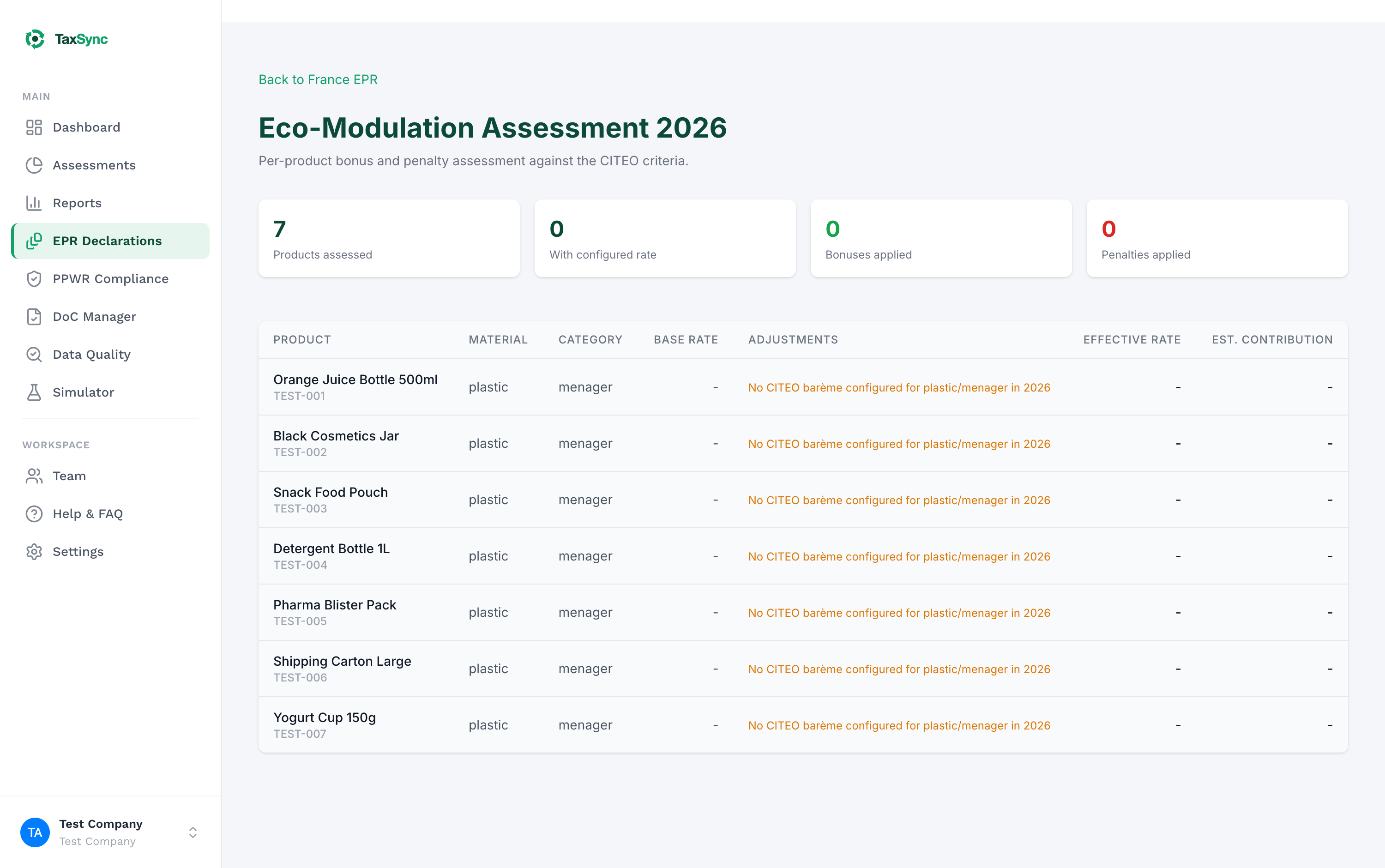
The platform evaluates your packaging against each scheme's eco-modulation criteria. It flags packaging that will incur surcharges and identifies opportunities for fee reductions such as high recycled content.
Report Generation
TaxSync generates ready-to-submit declarations for each scheme operator in a country-specific format. Every supported country has its own declaration formatter, from the German VerpackG data report to the CITEO declaration in France, exported as CSV files your scheme portal accepts.
Rate and Rule Updates
Fee tables and tax rates are maintained centrally and versioned by validity date. When a rate changes, company administrators are notified, and historical reports keep the rate that applied during their period.
Filing Reminders
The platform knows each scheme's filing calendar, including the German annual declaration due by 15 May and the French CITEO window that closes at the end of February. Administrators get reminder emails 30, 14, and 3 days before every deadline.
Countries Covered
TaxSync currently covers 15 European countries. EPR reporting is supported for Germany (LUCID and the dual systems), France (CITEO), Netherlands (Verpact), Belgium (Fost Plus), Austria (ARA), Portugal (SPV), Sweden (FTI), Poland (BDO), Ireland (Repak), Denmark (DPA), Norway (Gront Punkt), and Finland (Rinki). The United Kingdom, Spain, and Italy are covered through the Plastic Tax module with their own country-specific return formats.
Additional markets are added based on customer demand. If you operate in a country not yet on this list, contact us to discuss your timeline.