
Platform
The compliance engine behind your packaging operations: DoC generation, technical documentation, supplier data and integrations.
The Platform: Built for PPWR, Engineered for Compliance
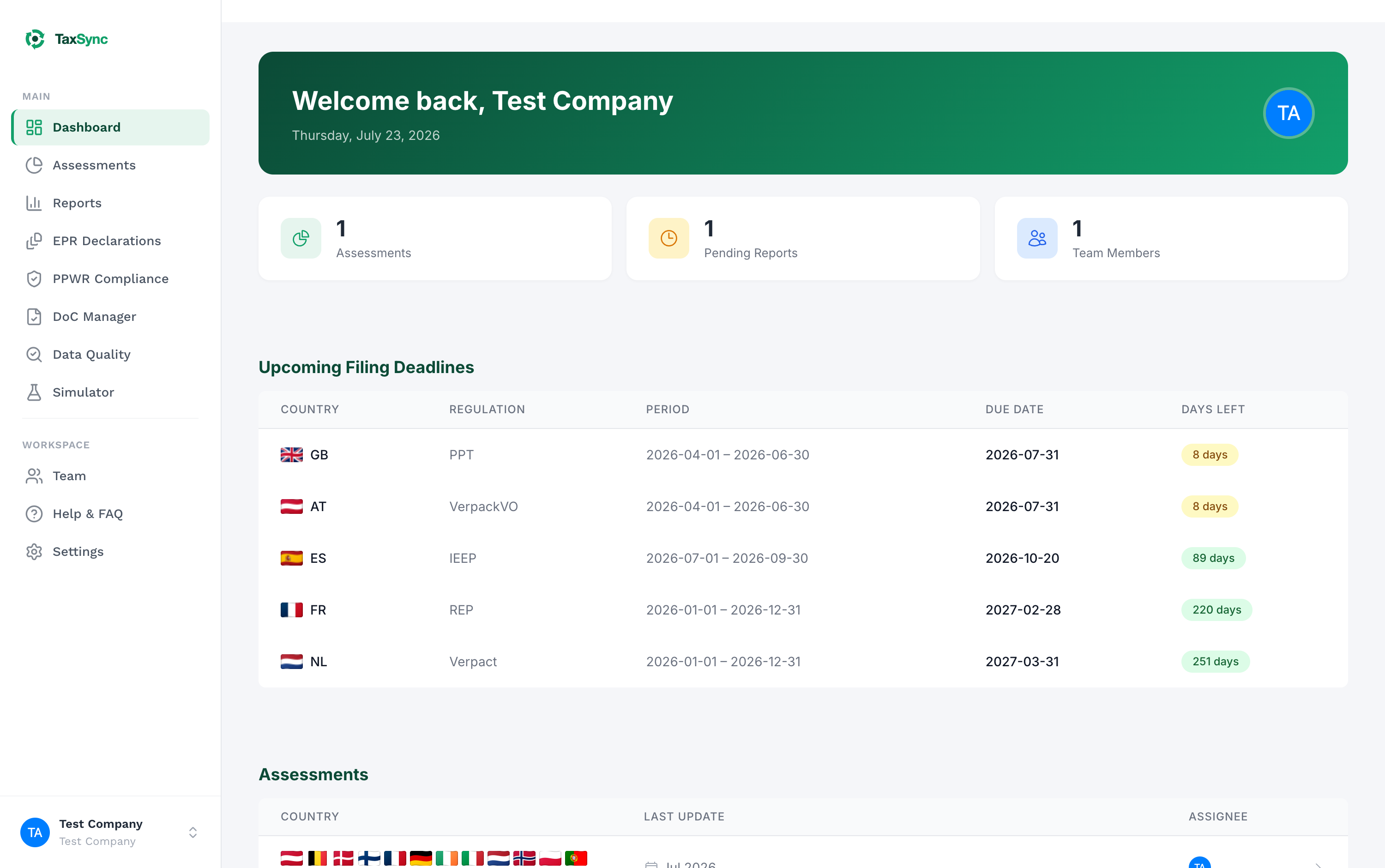
TaxSync is the compliance engine behind your packaging operations. It connects to your ERP, supplier systems, and GS1 data pools, normalises your packaging data, runs it against every applicable regulation, and produces audit-ready declarations — all from a single workspace.
Declaration of Conformity (DoC) Generator
From 12 August 2026, packaging cannot be placed on the EU market without a valid EU Declaration of Conformity. TaxSync generates DoC documents that follow the structure mandated by PPWR Annex VIII.
What the DoC contains:
- Unique identification number traceable to your internal system (e.g., SAP material number or GTIN).
- Full identification of the economic operator: name, trade name, registered address, and GLN.
- A statement that the declaration is issued under the sole responsibility of the economic operator.
- Identification of the packaging or packaging component (description, dimensions, weight, material composition).
- GS1 trade item data including GTIN, dimensions, gross weight, and sustainability attributes where available.
- Reference to the applicable PPWR requirements (Chapter III, Articles 5-11) and harmonised standards or technical specifications applied.
- Date of issue, signatory identification, and digital signature.
How it works:
- TaxSync runs a compliance assessment against every applicable PPWR requirement for each packaging format.
- The assessment checks recycled content against the 2030 and 2040 targets, evaluates recyclability under recognised frameworks, and validates packaging minimisation rules.
- If all requirements pass, the platform generates a DoC in PDF format ready for signing and filing.
- Batch generation lets you produce DoC documents across your entire product portfolio at once.
- All issued DoCs are versioned, timestamped, and stored with full audit trail for 10 years as required by PPWR.
Technical Documentation (Annex VII) Manager
Behind each DoC sits a technical file that documents the evidence supporting the declaration. TaxSync lets you upload and link test reports, material certificates, recyclability assessments, and supplier declarations to each product. The evidence library maintains version history and expiry tracking.
Key Features:
- Structured evidence repository.
- Substance compliance module (PFAS, heavy metals).
- Audit-ready access (10-day response).
- 10-year retention with expiry alerts.
Supplier Data Collection Module
The Technical Documentation relies on accurate data from your suppliers. TaxSync automates the collection and validation of supplier documentation.
Key Features:
- Automated Supplier Requests: Send structured requests for material declarations, PFAS and heavy metal confirmations, and recyclability data.
- Supplier Portal: Suppliers can upload their certifications and test reports directly.
- Data Validation: Automatically validate incoming data against GS1 code lists and regulatory requirements.
- Centralised Repository: All supplier documentation linked to the relevant packaging format.
Data Integration
Compliance calculations are only as good as the data behind them. TaxSync connects to your ERP, PLM, and GS1 data pools, and normalises everything into the formats required by tax authorities and EPR schemes.
Supported Integrations:
SAP (ECC and S/4HANA)
TaxSync reads material master records (MARA), Bills of Materials (BOM), MARM conversion factors, sales volumes (VBRP), and customs declarations. The integration handles SAP unit of measure codes (EH, ST, PAL, SMU) and normalises them to the weight-based units required by tax authorities.
Oracle (E-Business Suite and Cloud ERP)
For Oracle environments, the platform connects via REST API or database link. It maps Oracle item categories to the material classifications used by European regulators and pulls transaction data for sales volume calculations.
Microsoft Dynamics 365
Native connector for Dynamics 365 Finance and Supply Chain. TaxSync reads item records, packaging specifications, and sales orders, converting Dynamics data structures into the format needed for compliance reporting.
CSV and Excel Imports
For companies without direct ERP integration or for supplementary data (e.g., supplier packaging specs), TaxSync accepts structured CSV and Excel files. The import engine validates column mappings, checks for missing fields, and flags data quality issues before processing.
RESTful API
For custom or in-house systems, TaxSync provides a documented REST API. You can push packaging data, trigger calculations, and retrieve results programmatically. The API uses standard authentication (OAuth 2.0) and returns JSON responses.
GS1 GDSN and EDI Integration
EANCOM EDI (all 5 message types)
TaxSync processes all major EANCOM message types used in European packaging supply chains: PRICAT (product catalogues), DESADV (shipment and dispatch), ORDERS (purchase orders), INVOIC (invoices), and INVRPT (inventory reports). The platform parses inbound messages and generates outbound messages in the same format, enabling full bidirectional communication with trading partners.
GS1 GDSN (Global Data Synchronisation Network)
TaxSync connects to the three major European data pools: 1WorldSync, Sinfos (Germany), and SA2 Worldsync. When a supplier publishes or updates a trade item, TaxSync receives the Catalogue Item Notification (CIN) and extracts the packaging attributes relevant for compliance: material composition, dimensions, weights, recycled content percentages, and recyclability codes.
GS1 Code Lists
The platform includes a comprehensive registry of GS1-standardised code lists for packaging types, material codes, recycling process types, and measurement units. Bidirectional mapping translates between your internal codes and the GS1 standard codes expected by data pools and trading partners.
GTIN and GLN Management
Every product in TaxSync can carry a Global Trade Item Number (GTIN) and every company a Global Location Number (GLN). These identifiers link your compliance records directly to the GS1 global registry, ensuring traceability from the Declaration of Conformity through to the data pool publication.
Data Quality and Validation
Bad data leads to wrong calculations, which leads to penalties or overpayments. TaxSync includes a data quality layer that runs every time new data arrives.
- Completeness checks: The system verifies that every product has the required fields: material type, weight per component, packaging level (primary, secondary, transport), and market destination. Missing fields are flagged and routed to the responsible team for correction.
- Consistency checks: If a product's total packaging weight changes by more than 20% between imports, the system raises an alert. This catches data entry errors, unit-of-measure mismatches, and BOM changes that have not been properly reflected in master data.
- Material classification validation: TaxSync maps your internal material codes to the standard classifications used by each EU scheme (e.g., plastic subcategories for CONAI in Italy, paper grades for CITEO in France). If a material code cannot be mapped, it is queued for manual review rather than silently defaulting to a generic category.
- Duplicate detection: The platform identifies duplicate product records and consolidates them to prevent double-counting in declarations.
Data Architecture
TaxSync stores your packaging data in a normalised relational model optimised for compliance queries.
Key entities:
- Products: Your SKU catalogue with market-specific attributes (where it is sold, who is responsible for EPR in each market).
- Packaging Components: Individual components linked to products. Each component has a material type, weight, recycled content percentage, recyclability assessment, and packaging level (primary, secondary, transport).
- Transactions: Sales or production volumes per product, per market, per period. These drive the quantity-based calculations for EPR fees and tax declarations.
- Regulatory Rules: The fee tables, tax rates, exemption criteria, and reporting requirements for each jurisdiction. These are maintained by the regulatory team and versioned so you can see which rules applied to any historical calculation.
All data is encrypted at rest and in transit. Access is controlled by role-based permissions, and every read or write operation is logged for audit purposes. Your data never leaves the EU.