
PPWR Readiness
Recyclability grades, recycled content targets and Declarations of Conformity, measured against the 2030 requirements today.
PPWR Readiness
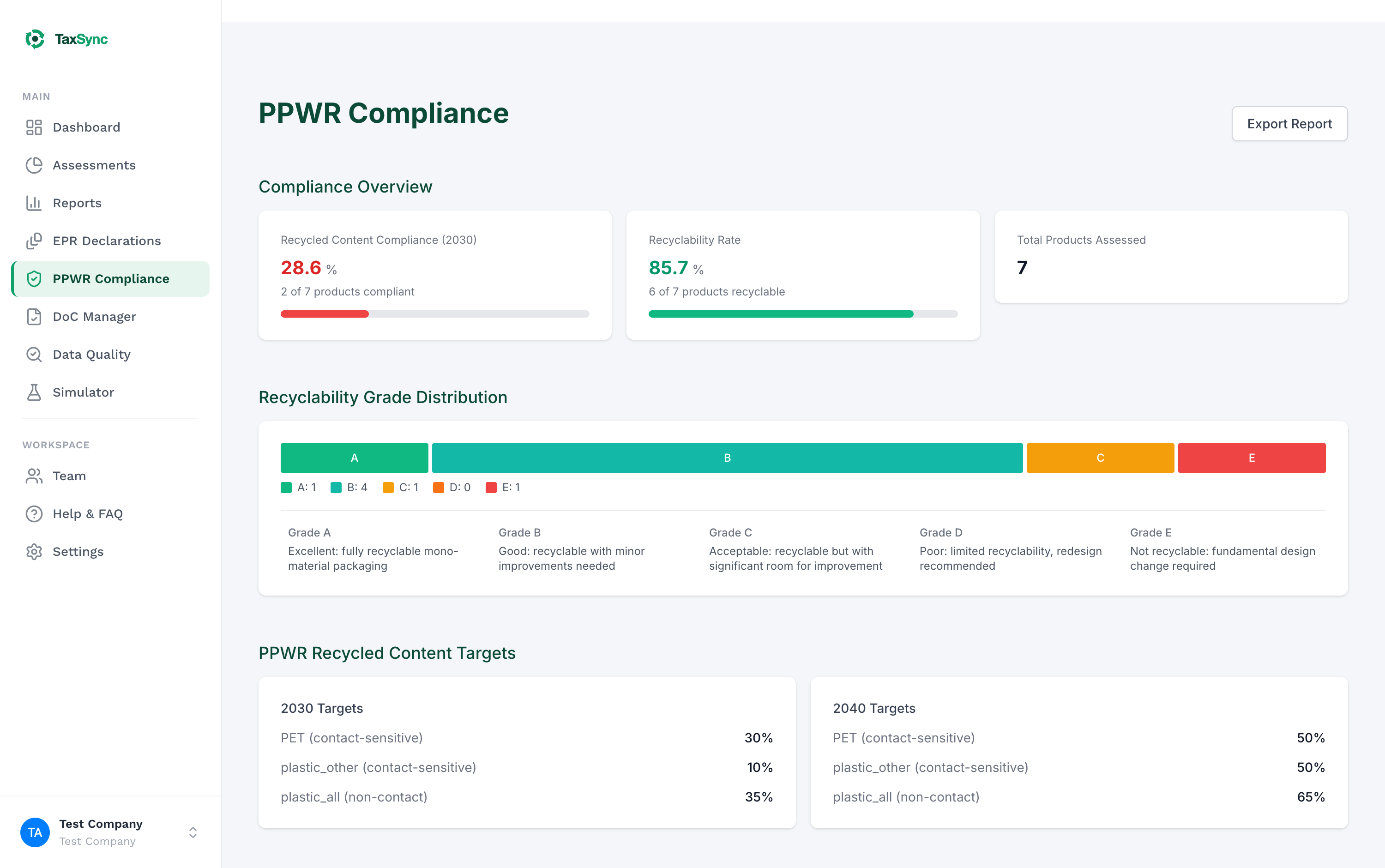
The EU Packaging and Packaging Waste Regulation (PPWR) was adopted in 2024 and replaces the old Packaging and Packaging Waste Directive (94/62/EC). Unlike a directive, a regulation applies directly across all EU member states without national transposition. This means one set of rules for the entire EU market.
The PPWR introduces binding targets for recycled content, recyclability requirements, restrictions on certain packaging formats, and new labelling obligations. For companies with complex packaging portfolios, preparation needs to start now because the first compliance deadlines begin in 2030.
TaxSync provides the tools to assess where your packaging stands today against PPWR requirements and what changes you need to make before each deadline.
Recycled Content Targets
The PPWR sets mandatory minimum recycled content targets for plastic packaging, measured as a percentage of plastic weight per packaging unit:
From 2030:
Contact-sensitive packaging (e.g., food-contact PET bottles): 10% recycled content.
Single-use plastic beverage bottles: 30% recycled content.
Other plastic packaging: 35% recycled content.
From 2040:
Contact-sensitive packaging: 50% recycled content.
Single-use plastic beverage bottles: 65% recycled content.
Other plastic packaging: 65% recycled content.
TaxSync evaluates each of your packaging items against these targets. The platform shows you which products already meet the 2030 thresholds, which ones are close, and which need significant changes. You can model "what-if" scenarios: for example, what happens to your compliance position if you switch a component from virgin PP to 40% rPP.
Recyclability Requirements
Under the PPWR, all packaging placed on the EU market must be recyclable. This is phased in:
From 2030: All packaging must be "designed for recycling" based on design-for-recycling criteria established by the European Commission. Packaging that does not meet these criteria cannot be placed on the EU market.
From 2035: Packaging must be recyclable "at scale", meaning collection and recycling infrastructure must actually exist for that packaging type and material in practice.
TaxSync assesses your packaging designs against RecyClass guidelines, KIDV recyclability protocols, and the emerging EU harmonised criteria. The platform flags components that are likely to fail: carbon black colorants (invisible to NIR sorters), multi-material laminates, non-detachable labels covering more than a threshold percentage of surface area, and problematic adhesive residues.
For each flagged item, TaxSync suggests alternatives: mono-material structures, compatible colorants, wash-off adhesives, or different material combinations that maintain functional requirements while improving recyclability scores.
Declaration of Conformity (DoC) Generator
From 12 August 2026, packaging cannot be placed on the EU market without a valid EU Declaration of Conformity. TaxSync generates DoC documents that follow the structure mandated by PPWR Annex VIII.
What the DoC contains:
- Unique identification number, enforced as unique at database level
- Full identification of the manufacturer: name, registered address, contact person, email, and phone
- EU Authorised Representative details when the manufacturer is established outside the EU
- A statement that the declaration is issued under the sole responsibility of the manufacturer
- Identification of the packaging: description, materials, GS1 trade item data including GTIN and dimensions where available
- Per-article conformity assessment covering PPWR Articles 5 to 12, with the reason recorded when an article does not apply (packaging type or a phase-in date not yet reached)
- Applied harmonised standards, marked as applied in full or in part
- Other applicable EU legislation such as REACH or food-contact regulations
- Notified body details where a conformity assessment body was involved
- Place of issue, date, and signatory identification
How it works:
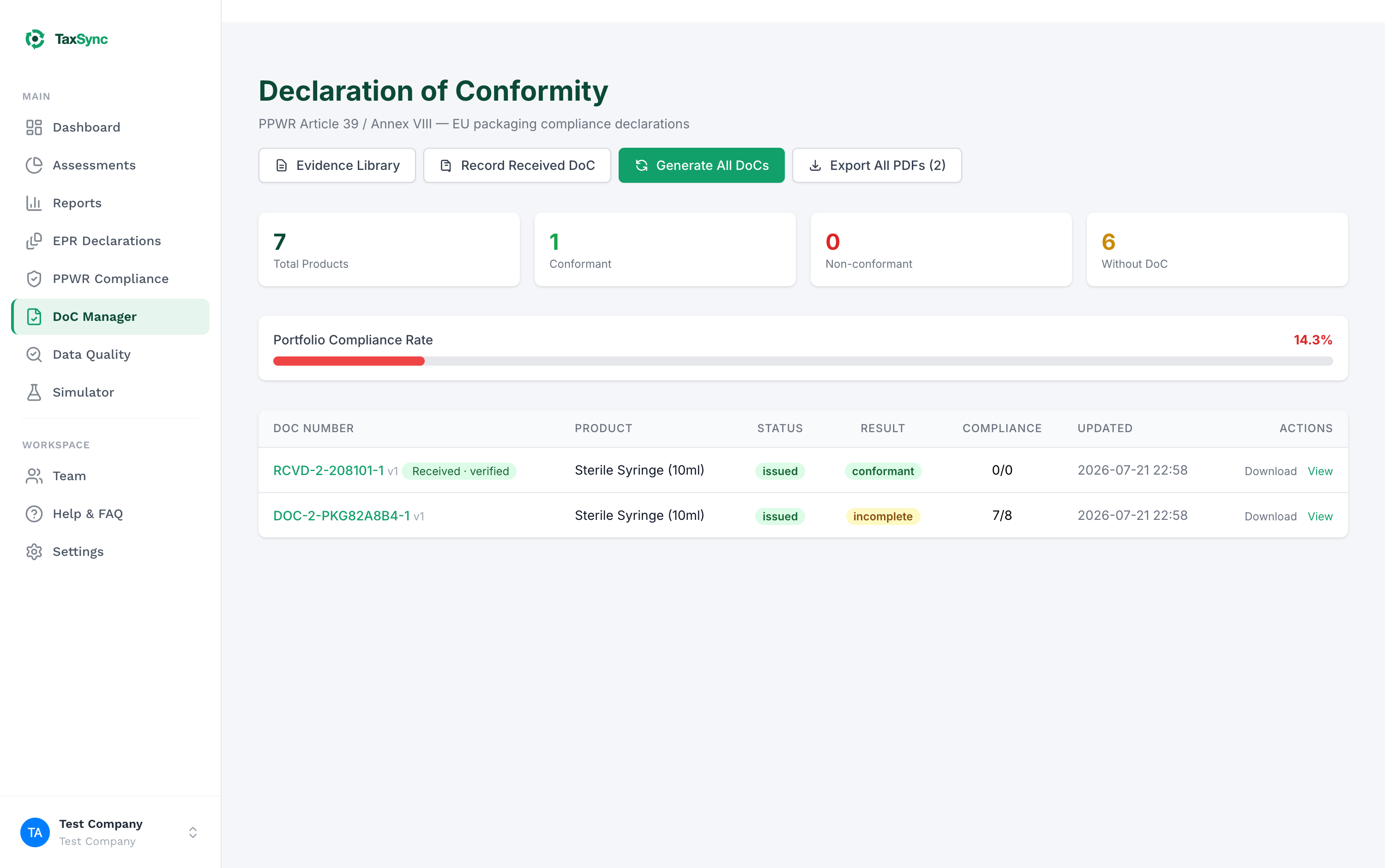
- TaxSync runs a compliance assessment against every applicable PPWR requirement for each packaging format
- If all requirements pass, the platform generates a DoC as PDF, in English, German, Spanish, French, or Italian
- Batch generation produces DoC documents across your entire product portfolio at once
- All issued DoCs are versioned and stored with the retention period the regulation requires: five years for single-use packaging and ten years for reusable packaging
Technical Documentation:
Behind each DoC sits a technical file that documents the evidence supporting the declaration. TaxSync lets you upload and link test reports, material certificates, recyclability assessments, and supplier declarations to each product. The evidence library maintains version history and expiry tracking.
Received Declarations of Conformity for Importers
If you import packaged goods into the EU, Article 18 of the PPWR requires you to hold a copy of the Declaration of Conformity for every packaging type you place on the market and keep it available for market surveillance authorities.
TaxSync handles this side of the obligation too:
- Record received DoCs: capture the supplier, their document reference, the date received, and the signed PDF itself, linked to the products it covers
- Verify against Annex VIII: a built-in checklist walks you through the required elements (unique number, manufacturer details, sole responsibility statement, conformity statement, standards, signature) before you mark a document as verified or reject it back to the supplier
- Retention done right: the original supplier PDF is archived unchanged for five years for single-use packaging and ten years for reusable packaging
- One register: generated and received DoCs live in the same list, so you always see which products are covered and which still need documents from suppliers
Packaging Minimisation and Restrictions
The PPWR introduces restrictions on specific packaging formats. Certain single-use packaging will be banned outright from 2030, including single-use packaging for fruits and vegetables under 1.5 kg, miniature toiletry packaging in hotels, and shrink wrap for grouped containers at retail.
The regulation also requires packaging minimisation under Article 10: you must demonstrate that your packaging is the minimum size and weight necessary to ensure product safety, hygiene, and consumer acceptance. Over-packaging, such as excessive void space or unnecessary secondary packaging, will no longer be permitted.
TaxSync tracks these restrictions against your product catalogue. When you import your packaging data, the platform checks each item against the restricted formats list and flags products that need redesign before the 2030 deadline.
Labelling and Digital Product Passport
The PPWR requires standardised labelling on all packaging to indicate material composition and proper disposal. By 2028, the European Commission will establish harmonised label designs, and all packaging will need to carry them.
Additionally, the regulation introduces a digital product passport (DPP) requirement for packaging. The DPP will contain information about material composition, recycled content, recyclability, and proper disposal instructions, accessible via a QR code or similar data carrier on each packaging item.
TaxSync is building DPP support into the platform. When the technical specifications are finalised, the system will generate DPP-compliant datasets from your existing packaging data and produce the required machine-readable output for each SKU.